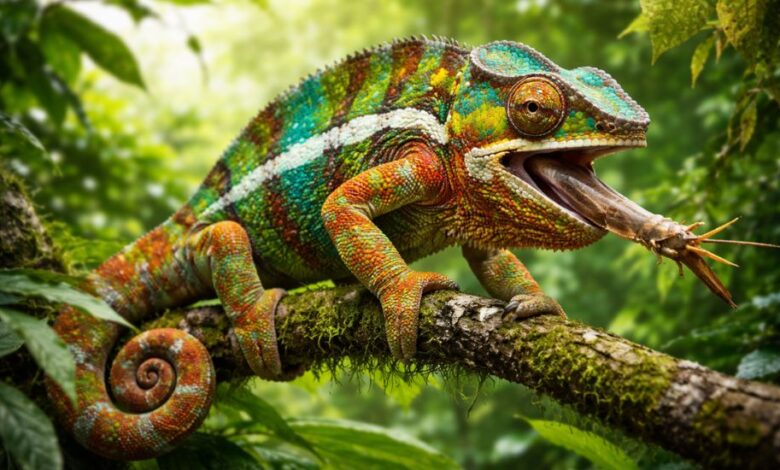
The family chameleónovité, scientifically known as Chamaeleonidae, represents one of the most extraordinary groups of reptiles on Earth. Instantly recognizable for their independently moving eyes, lightning-fast projectile tongues, and dramatic color shifts, chameleons have fascinated scientists, nature enthusiasts, and casual observers for centuries.
Although often associated purely with camouflage, chameleons are far more complex than their popular image suggests. Their color changes communicate mood and social signals, regulate body temperature, and help them respond to environmental conditions. Combined with their unique anatomy and diverse habitats, chameleónovité stand as a remarkable example of evolutionary specialization.
This article explores their taxonomy, distribution, anatomy, behavior, reproduction, ecological role, and conservation challenges in depth.
Taxonomy and Species Diversity
The family Chamaeleonidae includes roughly 150–200 recognized species, though the number continues to grow as researchers discover new species—particularly in remote forest regions. Taxonomic revisions are frequent, especially in biodiversity hotspots where isolated habitats have allowed species to evolve independently.
Chameleons belong to the order Squamata, which also includes snakes and other lizards. Within their family, several genera exist, many of which are endemic to specific geographic regions. Some species are widespread and adaptable, while others occupy extremely small ranges and are found nowhere else on Earth.
One of the most striking aspects of chameleónovité diversity is the incredible variation in size. The smallest known species measure only a few centimeters in length, while larger species can exceed 60 centimeters, including the tail.
Geographic Distribution: A Stronghold in Madagascar and Africa
Chameleons are primarily distributed across the Old World. Their greatest diversity occurs in Madagascar, where more than half of all known species live. This island nation serves as a global hotspot for chameleon evolution, with many species found only in specific forests or even single mountain ranges.
Beyond Madagascar, chameleons inhabit large areas of Africa, particularly sub-Saharan regions. They can be found in rainforests, dry woodlands, savannas, and mountainous regions.
Smaller populations also exist in parts of southern Europe, including Spain, as well as in the Middle East and South Asia. Their presence in Europe is limited compared to Africa and Madagascar but remains ecologically significant.
This geographic spread demonstrates their adaptability to varied climates—from humid tropical forests to arid scrublands.
Unique Anatomy and Physical Adaptations
Chameleónovité are evolutionary specialists, equipped with anatomical features that set them apart from all other reptiles.
1. Independently Moving Eyes
Perhaps their most iconic trait is their ability to move each eye independently. Each eye can rotate nearly 180 degrees, providing close to 360-degree vision without moving the head. This allows chameleons to scan for predators and prey simultaneously.
When targeting prey, both eyes focus forward to achieve precise depth perception—critical for accurate tongue projection.
2. Zygodactylous Feet
Their feet are structured like pincers, with toes grouped into opposing clusters. This arrangement enables a firm grip on branches, making them highly efficient climbers.
3. Prehensile Tail
Many species possess a prehensile tail that functions like a fifth limb, wrapping securely around branches to maintain balance.
4. Projectile Tongue
A chameleon’s tongue can extend up to twice its body length in some species. Powered by specialized muscles and elastic tissues, the tongue shoots out at remarkable speed to capture insects. The sticky tip ensures a secure hold before retracting the prey back into the mouth.
5. Color-Changing Skin
Contrary to popular belief, chameleons do not change color solely to match their surroundings. Their skin contains layers of specialized cells—chromatophores and structural cells called iridophores—that reflect and refract light.
Color change plays a major role in:
-
Social signaling (dominance, aggression, mating readiness)
-
Temperature regulation
-
Stress response
-
Environmental interaction
Bright colors often signal dominance or courtship, while darker tones may indicate stress or submission.
Behavior and Lifestyle
Most chameleons are arboreal, meaning they spend the majority of their lives in trees and shrubs. Their slow, deliberate movements resemble leaves swaying in the wind—an adaptation that reduces detection by predators.
Chameleons are generally solitary animals. They maintain territories and may display aggressive coloration and body postures when confronting rivals.
A well-known example is the Panther chameleon of Madagascar. Males display vivid reds, blues, greens, and yellows during courtship or territorial disputes, showcasing the importance of visual communication.
Their diet consists primarily of insects such as crickets, grasshoppers, and beetles. Larger species may consume small birds or other lizards.
Reproduction and Life Cycle
Reproductive strategies vary widely among chameleónovité.
Oviparous Species (Egg-Laying)
Most chameleons lay eggs. Females dig holes in soil or sand where they deposit clutches that can range from a few eggs to more than 50, depending on the species. Incubation periods may last several months.
Viviparous Species (Live Birth)
Some species—particularly those living in cooler mountainous environments—give birth to live young. This adaptation is beneficial in climates where external egg incubation would be risky due to low temperatures.
Juvenile chameleons are independent from birth or hatching and receive no parental care.
Ecological Importance
Chameleons play an essential role in maintaining ecological balance. As insectivores, they help regulate insect populations, including agricultural pests.
They also serve as prey for birds, snakes, and mammals, forming part of the broader food web.
Because many species are highly sensitive to environmental changes, they act as bioindicators. A decline in chameleon populations often signals habitat degradation.
Conservation Challenges
Despite their adaptability, many species of chameleónovité face significant threats.
Habitat Loss
Deforestation in Madagascar and Africa poses the greatest danger. Forest clearing for agriculture, logging, and urban expansion reduces available habitat.
Climate Change
Changes in rainfall and temperature patterns can impact breeding cycles and food availability.
Illegal Pet Trade
Chameleons are popular in the exotic pet market. While some species are bred in captivity, wild collection continues in certain regions.
Many species are assessed under the IUCN Red List, with statuses ranging from Least Concern to Critically Endangered.
Conservation efforts focus on habitat protection, regulated trade, and environmental education. Madagascar, in particular, remains central to global chameleon conservation strategies.
Scientific Research and Ongoing Discoveries
The study of chameleons continues to reveal surprising insights. Advances in imaging technology have clarified the structural basis of color change, while genetic studies have reshaped taxonomic classifications.
New species are still being described, especially in remote Madagascan forests. These discoveries emphasize both the richness of biodiversity and the urgency of conservation.
Researchers are also examining how chameleons may adapt to urban and fragmented environments, providing broader insight into reptilian resilience.
Cultural and Symbolic Significance
Chameleons often symbolize adaptability, transformation, and change. Their ability to shift color has made them metaphors in literature, politics, and psychology.
However, these symbolic interpretations sometimes oversimplify their biology. Scientifically, their color-changing ability is not deception but communication and physiological regulation—a sophisticated biological system shaped by millions of years of evolution.
Conclusion
Chameleónovité represent one of nature’s most specialized reptile families. From their independently rotating eyes and rapid-fire tongues to their complex color displays and diverse reproductive strategies, they are masterpieces of evolutionary innovation.
Their stronghold in Madagascar and Africa highlights the importance of regional biodiversity conservation. As habitat destruction and climate change accelerate, safeguarding these extraordinary reptiles becomes increasingly urgent.
Understanding chameleons not only deepens appreciation for reptilian diversity but also underscores the interconnectedness of ecosystems worldwide. Continued research and conservation action are essential to ensure that future generations can witness the remarkable biology of chameleónovité.
For more in-depth explorations of wildlife science, biodiversity, and emerging research trends, readers can visit the blog site Technologies Era, where nature and innovation intersect in engaging, educational content.
You may also read: Choosing the Right Min Pin Breeders